

University of Duisburg-Essen, House of Energy, Climate, and Finance
2025-06-30
\[ \newcommand{\A}{{\mathbb A}} \]
Artwork by @allison_horst
| Energy market liberalization created complex, interconnected trading systems | |
| Renewable energy transition introduces uncertainty and volatility from weather-dependent generation | |
| Traditional point forecasts are inadequate for modern energy markets with increasing uncertainty | |
| Risk inherently is a probabilistic concept | |
| Probabilistic forecasting essential for risk management, planning and decision making in volatile energy environments | |
| Online learning methods needed for fast-updating models with streaming energy data |

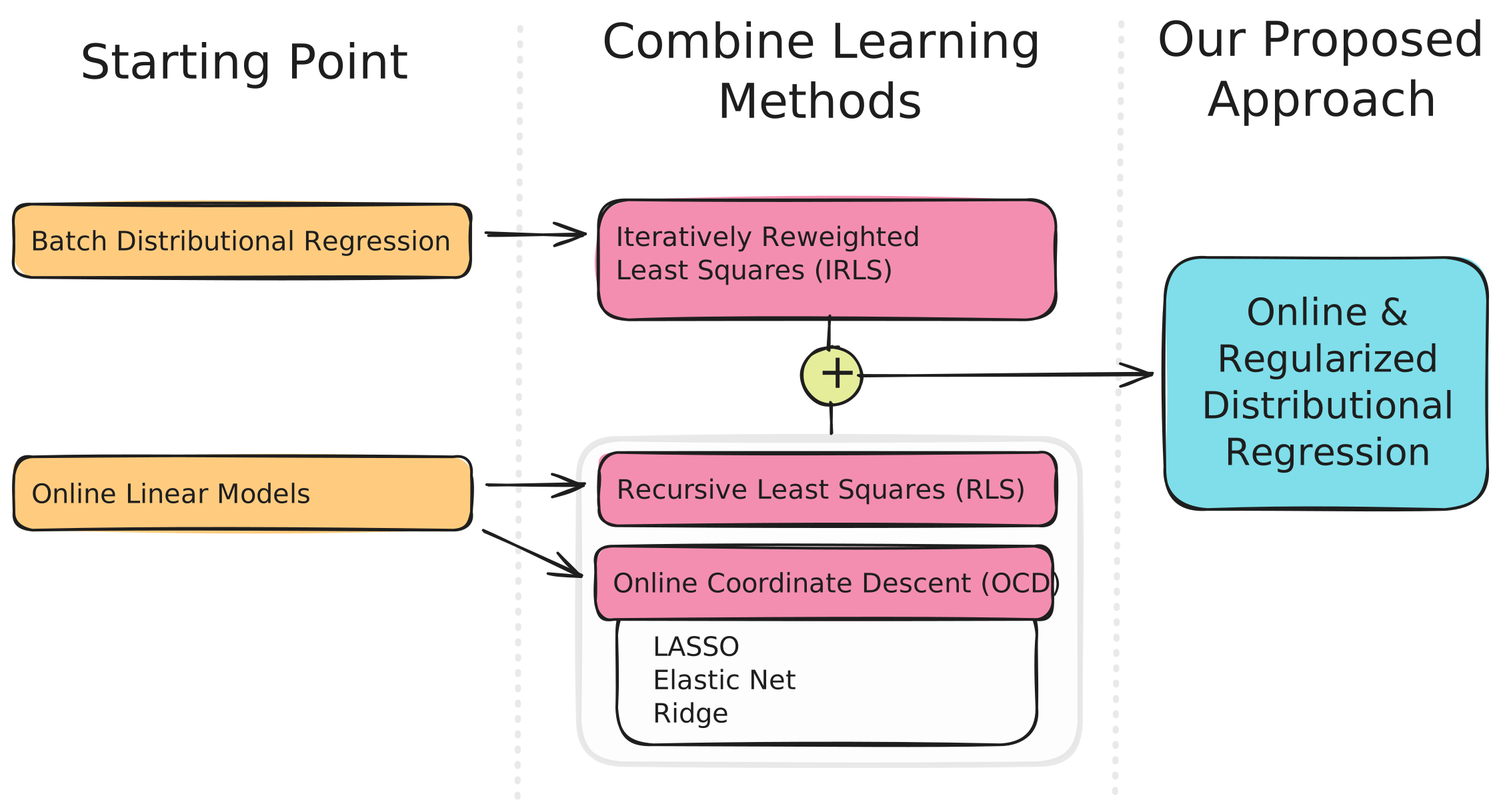
| Berrisch, J., & Ziel, F. (2023). CRPS learning. Journal of Econometrics, 237(2), 105221. | |
| Berrisch, J., & Ziel, F. (2024). Multivariate probabilistic CRPS learning with an application to day-ahead electricity prices. International Journal of Forecasting, 40(4), 1568–1586. | |
| Hirsch, S., Berrisch, J., & Ziel, F. (2024). Online Distributional Regression. arXiv preprint arXiv:2407.08750. | |
| Berrisch, J., & Ziel, F. (2022). Distributional modeling and forecasting of natural gas prices. Journal of Forecasting, 41(6), 1065–1086. | |
| Berrisch, J., Pappert, S., Ziel, F., & Arsova, A. (2023). Modeling volatility and dependence of European carbon and energy prices. Finance Research Letters, 52, 103503. | |
| Berrisch, J., Narajewski, M., & Ziel, F. (2023). High-resolution peak demand estimation using generalized additive models and deep neural networks. Energy and AI, 13, 100236. | |
| Berrisch, J. (2025). rcpptimer: Rcpp Tic-Toc Timer with OpenMP Support. arXiv preprint arXiv:2501.15856. |
| Berrisch, J., & Ziel, F. (2023). CRPS learning. Journal of Econometrics, 237(2), 105221. | |
| Berrisch, J., & Ziel, F. (2024). Multivariate probabilistic CRPS learning with an application to day-ahead electricity prices. International Journal of Forecasting, 40(4), 1568–1586. | |
| Hirsch, S., Berrisch, J., & Ziel, F. (2024). Online Distributional Regression. arXiv preprint arXiv:2407.08750. | |
| Berrisch, J., & Ziel, F. (2022). Distributional modeling and forecasting of natural gas prices. Journal of Forecasting, 41(6), 1065–1086. | |
| Berrisch, J., Pappert, S., Ziel, F., & Arsova, A. (2023). Modeling volatility and dependence of European carbon and energy prices. Finance Research Letters, 52, 103503. | |
| Berrisch, J., Narajewski, M., & Ziel, F. (2023). High-resolution peak demand estimation using generalized additive models and deep neural networks. Energy and AI, 13, 100236. | |
| Berrisch, J. (2025). rcpptimer: Rcpp Tic-Toc Timer with OpenMP Support. arXiv preprint arXiv:2501.15856. |
| Berrisch, J., & Ziel, F. (2023). CRPS learning. Journal of Econometrics, 237(2), 105221. | |
| Berrisch, J., & Ziel, F. (2024). Multivariate probabilistic CRPS learning with an application to day-ahead electricity prices. International Journal of Forecasting, 40(4), 1568–1586. | |
| Hirsch, S., Berrisch, J., & Ziel, F. (2024). Online Distributional Regression. arXiv preprint arXiv:2407.08750. | |
| Berrisch, J., & Ziel, F. (2022). Distributional modeling and forecasting of natural gas prices. Journal of Forecasting, 41(6), 1065–1086. | |
| Berrisch, J., Pappert, S., Ziel, F., & Arsova, A. (2023). Modeling volatility and dependence of European carbon and energy prices. Finance Research Letters, 52, 103503. | |
| Berrisch, J., Narajewski, M., & Ziel, F. (2023). High-resolution peak demand estimation using generalized additive models and deep neural networks. Energy and AI, 13, 100236. | |
| Berrisch, J. (2025). rcpptimer: Rcpp Tic-Toc Timer with OpenMP Support. arXiv preprint arXiv:2501.15856. |
Reduces estimation time by 2-3 orders of magnitude
Maintainins competitive forecasting accuracy
Real-World Validation in Energy Markets
Predict high-resolution electricity peaks using only low-resolution data
Combine GAMs and DNN’s for superior accuracy
Won Western Power Distribution Competition
Won Best-Student-Presentation Award
Berrisch, J., & Ziel, F. (2023). Journal of Econometrics, 237(2), 105221.
The Idea:
Combine multiple forecasts instead of choosing one
Combination weights may vary over time, over the distribution or both
2 Popular options for combining distributions:
Each day, \(t = 1, 2, ... T\)
Weights are updated sequentially according to the past performance of the \(K\) experts.
That is, a loss function \(\ell\) is needed. This is used to compute the cumulative regret \(R_{t,k}\)
\[\begin{equation} R_{t,k} = \widetilde{L}_{t} - \widehat{L}_{t,k} = \sum_{i = 1}^t \ell(\widetilde{X}_{i},Y_i) - \ell(\widehat{X}_{i,k},Y_i)\label{eq:regret} \end{equation}\]
The cumulative regret:
Popular loss functions for point forecasting Gneiting (2011):
\(\ell_2\) loss:
\[\begin{equation} \ell_2(x, y) = | x -y|^2 \label{eq:elltwo} \end{equation}\]
Strictly proper for mean prediction
\(\ell_1\) loss:
\[\begin{equation} \ell_1(x, y) = | x -y| \label{eq:ellone} \end{equation}\]
Strictly proper for median predictions
\[\begin{equation} w_{t,k}^{\text{Naive}} = \frac{1}{K}\label{eq:naive_combination} \end{equation}\]
\[\begin{equation} \begin{aligned} w_{t,k}^{\text{EWA}} & = \frac{e^{\eta R_{t,k}} }{\sum_{k = 1}^K e^{\eta R_{t,k}}}\\ & = \frac{e^{-\eta \ell(\widehat{X}_{t,k},Y_t)} w^{\text{EWA}}_{t-1,k} }{\sum_{k = 1}^K e^{-\eta \ell(\widehat{X}_{t,k},Y_t)} w^{\text{EWA}}_{t-1,k}} \end{aligned}\label{eq:exp_combination} \end{equation}\]
In stochastic settings, the cumulative Risk should be analyzed Wintenberger (2017): \[\begin{align} &\underbrace{\widetilde{\mathcal{R}}_t = \sum_{i=1}^t \mathbb{E}[\ell(\widetilde{X}_{i},Y_i)|\mathcal{F}_{i-1}]}_{\text{Cumulative Risk of Forecaster}} \\ &\underbrace{\widehat{\mathcal{R}}_{t,k} = \sum_{i=1}^t \mathbb{E}[\ell(\widehat{X}_{i,k},Y_i)|\mathcal{F}_{i-1}]}_{\text{Cumulative Risk of Experts}} \label{eq_def_cumrisk} \end{align}\]
\[\begin{equation} \frac{1}{t}\left(\widetilde{\mathcal{R}}_t - \widehat{\mathcal{R}}_{t,\min} \right) \stackrel{t\to \infty}{\rightarrow} a \quad \text{with} \quad a \leq 0. \label{eq_opt_select} \end{equation}\] The forecaster is asymptotically not worse than the best expert \(\widehat{\mathcal{R}}_{t,\min}\).
\[\begin{equation} \frac{1}{t}\left(\widetilde{\mathcal{R}}_t - \widehat{\mathcal{R}}_{t,\pi} \right) \stackrel{t\to \infty}{\rightarrow} b \quad \text{with} \quad b \leq 0 . \label{eq_opt_conv} \end{equation}\] The forecaster is asymptotically not worse than the best convex combination \(\widehat{X}_{t,\pi}\) in hindsight (oracle).
Optimal rates with respect to selection \(\eqref{eq_opt_select}\) and convex aggregation \(\eqref{eq_opt_conv}\) Wintenberger (2017):
\[\begin{align} \frac{1}{t}\left(\widetilde{\mathcal{R}}_t - \widehat{\mathcal{R}}_{t,\min} \right) & = \mathcal{O}\left(\frac{\log(K)}{t}\right)\label{eq_optp_select} \end{align}\]
\[\begin{align} \frac{1}{t}\left(\widetilde{\mathcal{R}}_t - \widehat{\mathcal{R}}_{t,\pi} \right) & = \mathcal{O}\left(\sqrt{\frac{\log(K)}{t}}\right) \label{eq_optp_conv} \end{align}\]
Algorithms can statisfy both \(\eqref{eq_optp_select}\) and \(\eqref{eq_optp_conv}\) depending on:
EWA satisfies optimal selection convergence \(\eqref{eq_optp_select}\) in a deterministic setting if:
Those results can be converted to any stochastic setting Wintenberger (2017).
Optimal convex aggregation convergence \(\eqref{eq_optp_conv}\) can be satisfied by applying the kernel-trick:
\[\begin{align} \ell^{\nabla}(x,y) = \ell'(\widetilde{X},y) x \end{align}\]
\(\ell'\) is the subgradient of \(\ell\) at forecast combination \(\widetilde{X}\).
An appropriate choice:
\[\begin{equation*} \text{CRPS}(F, y) = \int_{\mathbb{R}} {(F(x) - \mathbb{1}\{ x > y \})}^2 dx \label{eq:crps} \end{equation*}\]
It’s strictly proper Gneiting & Raftery (2007).
Using the CRPS, we can calculate time-adaptive weights \(w_{t,k}\). However, what if the experts’ performance varies in parts of the distribution?
Utilize this relation:
\[\begin{equation*} \text{CRPS}(F, y) = 2 \int_0^{1} \text{QL}_p(F^{-1}(p), y) dp.\label{eq_crps_qs} \end{equation*}\]
… to combine quantiles of the probabilistic forecasts individually using the quantile-loss QL.
QL is convex, but not exp-concave
Bernstein Online Aggregation (BOA) lets us weaken the exp-concavity condition. It satisfies that there exist a \(C>0\) such that for \(x>0\) it holds that
\[\begin{equation} P\left( \frac{1}{t}\left(\widetilde{\mathcal{R}}_t - \widehat{\mathcal{R}}_{t,\pi} \right) \leq C \log(\log(t)) \left(\sqrt{\frac{\log(K)}{t}} + \frac{\log(K)+x}{t}\right) \right) \geq 1-e^{-x} \label{eq_boa_opt_conv} \end{equation}\]
Almost optimal w.r.t. convex aggregation \(\eqref{eq_optp_conv}\) Wintenberger (2017).
The same algorithm satisfies that there exist a \(C>0\) such that for \(x>0\) it holds that \[\begin{equation} P\left( \frac{1}{t}\left(\widetilde{\mathcal{R}}_t - \widehat{\mathcal{R}}_{t,\min} \right) \leq C\left(\frac{\log(K)+\log(\log(Gt))+ x}{\alpha t}\right)^{\frac{1}{2-\beta}} \right) \geq 1-2e^{-x} \label{eq_boa_opt_select} \end{equation}\]
if \(Y_t\) is bounded, the considered loss \(\ell\) is convex \(G\)-Lipschitz and weak exp-concave in its first coordinate.
Almost optimal w.r.t. selection \(\eqref{eq_optp_select}\) Gaillard & Wintenberger (2018).
We show that this holds for QL under feasible conditions.
Lemma 1
\[\begin{align} 2\overline{\widehat{\mathcal{R}}}^{\text{QL}}_{t,\min} & \leq \widehat{\mathcal{R}}^{\text{CRPS}}_{t,\min} \label{eq_risk_ql_crps_expert} \\ 2\overline{\widehat{\mathcal{R}}}^{\text{QL}}_{t,\pi} & \leq \widehat{\mathcal{R}}^{\text{CRPS}}_{t,\pi} . \label{eq_risk_ql_crps_convex} \end{align}\]
Pointwise can outperform constant procedures
QL is convex but not exp-concave:
Almost optimal convergence w.r.t. convex aggregation \(\eqref{eq_boa_opt_conv}\)
For almost optimal congerence w.r.t. selection \(\eqref{eq_boa_opt_select}\) we need to check A1 and A2:
QL is Lipschitz continuous:
A1 holds
A1
For some \(G>0\) it holds for all \(x_1,x_2\in \mathbb{R}\) and \(t>0\) that
\[ | \ell(x_1, Y_t)-\ell(x_2, Y_t) | \leq G |x_1-x_2|\]
A2 For some \(\alpha>0\), \(\beta\in[0,1]\) it holds for all \(x_1,x_2 \in \mathbb{R}\) and \(t>0\) that
\[\begin{align*} \mathbb{E}[ & \ell(x_1, Y_t)-\ell(x_2, Y_t) | \mathcal{F}_{t-1}] \leq \\ & \mathbb{E}[ \ell'(x_1, Y_t)(x_1 - x_2) |\mathcal{F}_{t-1}] \\ & + \mathbb{E}\left[ \left. \left( \alpha(\ell'(x_1, Y_t)(x_1 - x_2))^{2}\right)^{1/\beta} \right|\mathcal{F}_{t-1}\right] \end{align*}\]
Almost optimal w.r.t. selection \(\eqref{eq_optp_select}\) Gaillard & Wintenberger (2018).
Conditional quantile risk: \(\mathcal{Q}_p(x) = \mathbb{E}[ \text{QL}_p(x, Y_t) | \mathcal{F}_{t-1}]\).
convexity properties of \(\mathcal{Q}_p\) depend on the conditional distribution \(Y_t|\mathcal{F}_{t-1}\).
Proposition 1
Let \(Y\) be a univariate random variable with (Radon-Nikodym) \(\nu\)-density \(f\), then for the second subderivative of the quantile risk \(\mathcal{Q}_p(x) = \mathbb{E}[ \text{QL}_p(x, Y) ]\) of \(Y\) it holds for all \(p\in(0,1)\) that \(\mathcal{Q}_p'' = f.\) Additionally, if \(f\) is a continuous Lebesgue-density with \(f\geq\gamma>0\) for some constant \(\gamma>0\) on its support \(\text{spt}(f)\) then is \(\mathcal{Q}_p\) is \(\gamma\)-strongly convex.
Strong convexity with \(\beta=1\) implies weak exp-concavity A2 Gaillard & Wintenberger (2018)
A1 and A2 give us almost optimal convergence w.r.t. selection \(\eqref{eq_boa_opt_select}\)
Theorem 1
The gradient based fully adaptive Bernstein online aggregation (BOAG) applied pointwise for all \(p\in(0,1)\) on \(\text{QL}\) satisfies \(\eqref{eq_boa_opt_conv}\) with minimal CRPS given by
\[\widehat{\mathcal{R}}_{t,\pi} = 2\overline{\widehat{\mathcal{R}}}^{\text{QL}}_{t,\pi}.\]
If \(Y_t|\mathcal{F}_{t-1}\) is bounded and has a pdf \(f_t\) satifying \(f_t>\gamma >0\) on its support \(\text{spt}(f_t)\) then \(\ref{eq_boa_opt_select}\) holds with \(\beta=1\) and
\[\widehat{\mathcal{R}}_{t,\min} = 2\overline{\widehat{\mathcal{R}}}^{\text{QL}}_{t,\min}\].
Simple Example:
\[\begin{align} Y_t & \sim \mathcal{N}(0,\,1) \\ \widehat{X}_{t,1} & \sim \widehat{F}_{1} = \mathcal{N}(-1,\,1) \\ \widehat{X}_{t,2} & \sim \widehat{F}_{2} = \mathcal{N}(3,\,4) \label{eq:dgp_sim1} \end{align}\]
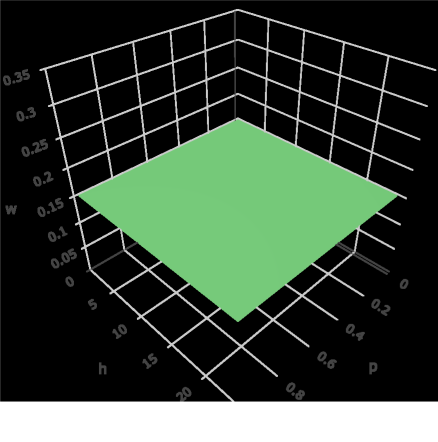
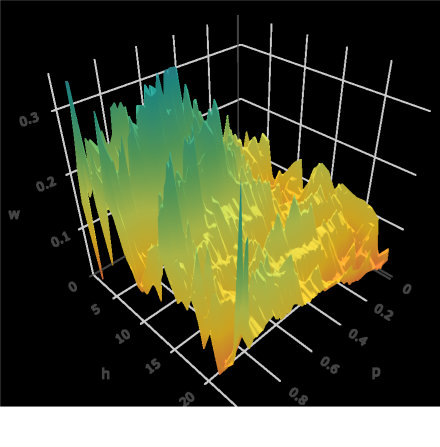
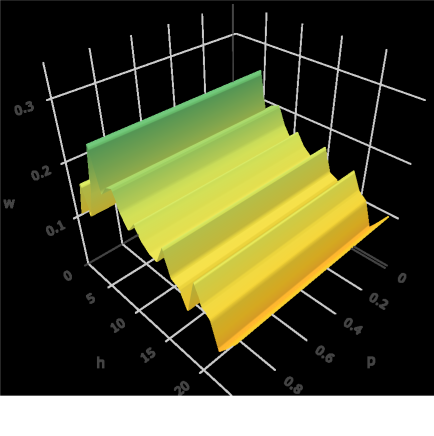
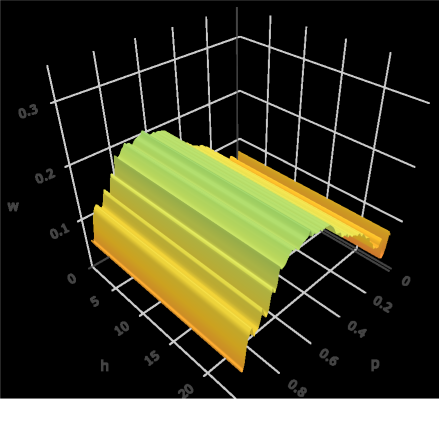
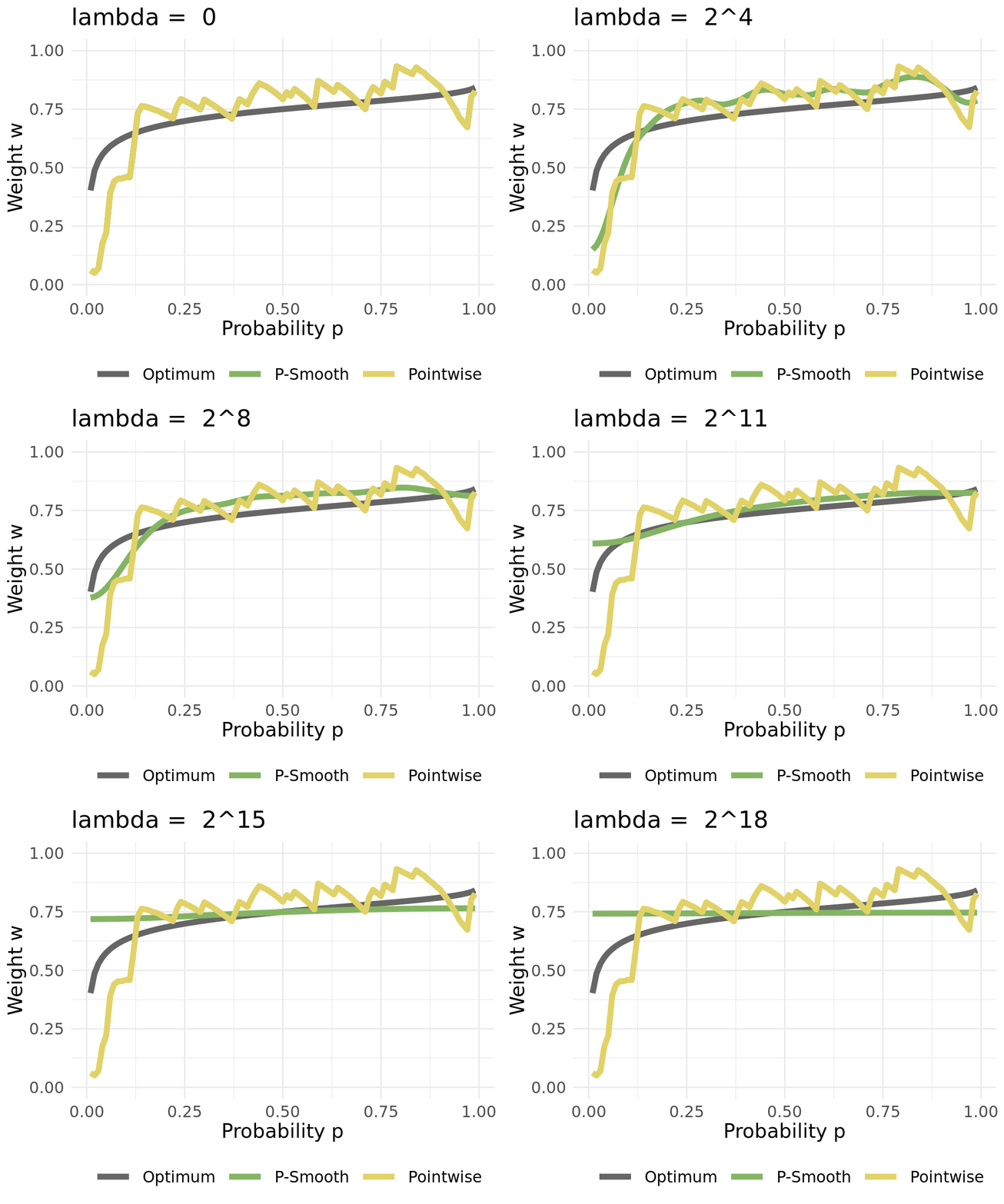
Penalized cubic B-Splines for smoothing weights:
Let \(\varphi=(\varphi_1,\ldots, \varphi_L)\) be bounded basis functions on \((0,1)\) Then we approximate \(w_{t,k}\) by
\[\begin{align} w_{t,k}^{\text{smooth}} = \sum_{l=1}^L \beta_l \varphi_l = \beta'\varphi \end{align}\]
with parameter vector \(\beta\). The latter is estimated to penalize \(L_2\)-smoothing which minimizes
\[\begin{equation} \| w_{t,k} - \beta' \varphi \|^2_2 + \lambda \| \mathcal{D}^{d} (\beta' \varphi) \|^2_2 \label{eq_function_smooth} \end{equation}\]
with differential operator \(\mathcal{D}\)
Computation is easy, since we have an analytical solution
We receive the constant solution for high values of \(\lambda\) when setting \(d=1\)
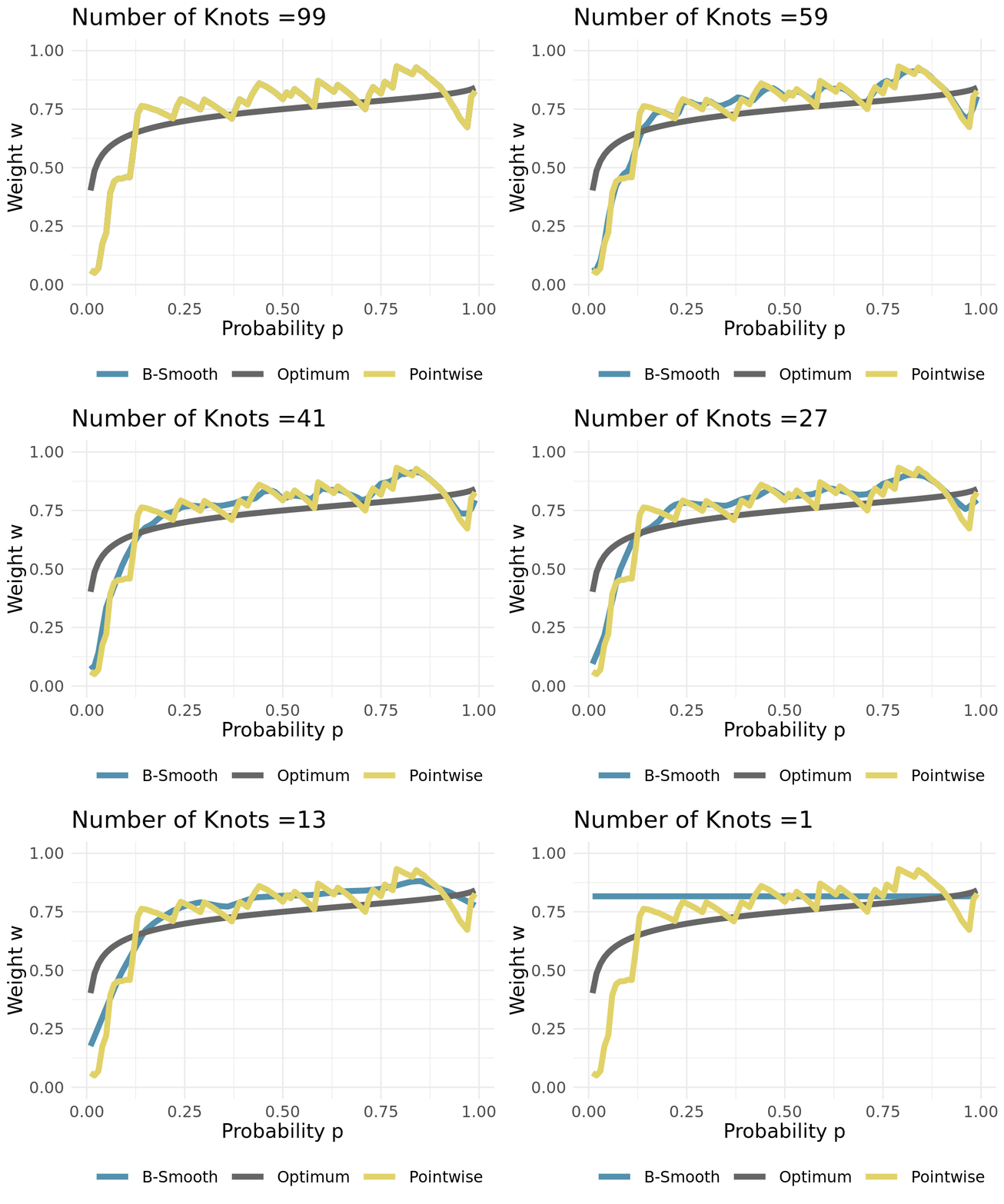
Represent weights as linear combinations of bounded basis functions:
\[\begin{equation} w_{t,k} = \sum_{l=1}^L \beta_{t,k,l} \varphi_l = \boldsymbol \beta_{t,k}' \boldsymbol \varphi \end{equation}\]
A popular choice are are B-Splines as local basis functions
\(\boldsymbol \beta_{t,k}\) is calculated using a reduced regret matrix:
\[\begin{equation} \underbrace{\boldsymbol r_{t}}_{\text{LxK}} = \frac{L}{P} \underbrace{\boldsymbol B'}_{\text{LxP}} \underbrace{\left({\boldsymbol{QL}}_{\mathcal{P}}^{\nabla}(\widetilde{\boldsymbol X}_{t},Y_t)- {\boldsymbol{QL}}_{\mathcal{P}}^{\nabla}(\widehat{\boldsymbol X}_{t},Y_t)\right)}_{\text{PxK}} \end{equation}\]
\(\boldsymbol r_{t}\) is transformed from PxK to LxK
If \(L = P\) it holds that \(\boldsymbol \varphi = \boldsymbol{I}\) For \(L = 1\) we receive constant weights
Weights converge to the constant solution if \(L\rightarrow 1\)
Array of expert predicitons: \(\widehat{X}_{t,p,k}\)
Vector of Prediction targets: \(Y_t\)
Starting Weights: \(\boldsymbol w_0=(w_{0,1},\ldots, w_{0,K})\)
Penalization parameter: \(\lambda\geq 0\)
B-spline and penalty matrices \(\boldsymbol B\) and \(\boldsymbol D\) on \(\mathcal{P}= (p_1,\ldots,p_M)\)
Hat matrix: \[\boldsymbol{\mathcal{H}} = \boldsymbol B(\boldsymbol B'\boldsymbol B+ \lambda (\alpha \boldsymbol D_1'\boldsymbol D_1 + (1-\alpha) \boldsymbol D_2'\boldsymbol D_2))^{-1} \boldsymbol B'\]
Cumulative Regret: \(R_{0,k} = 0\)
Range parameter: \(E_{0,k}=0\)
Starting pseudo-weights: \(\boldsymbol \beta_0 = \boldsymbol B^{\text{pinv}}\boldsymbol w_0(\boldsymbol{\mathcal{P}})\)
for( t in 1:T ) {
\(\widetilde{\boldsymbol X}_{t} = \text{Sort}\left( \boldsymbol w_{t-1}'(\boldsymbol P) \widehat{\boldsymbol X}_{t} \right)\) # Prediction
\(\boldsymbol r_{t} = \frac{L}{M} \boldsymbol B' \left({\boldsymbol{QL}}_{\boldsymbol{\mathcal P}}^{\nabla}(\widetilde{\boldsymbol X}_{t},Y_t)- {\boldsymbol{QL}}_{\boldsymbol{\mathcal P}}^{\nabla}(\widehat{\boldsymbol X}_{t},Y_t)\right)\)
\(\boldsymbol E_{t} = \max(\boldsymbol E_{t-1}, \boldsymbol r_{t}^+ + \boldsymbol r_{t}^-)\)
\(\boldsymbol V_{t} = \boldsymbol V_{t-1} + \boldsymbol r_{t}^{ \odot 2}\)
\(\boldsymbol \eta_{t} =\min\left( \left(-\log(\boldsymbol \beta_{0}) \odot \boldsymbol V_{t}^{\odot -1} \right)^{\odot\frac{1}{2}} , \frac{1}{2}\boldsymbol E_{t}^{\odot-1}\right)\)
\(\boldsymbol R_{t} = \boldsymbol R_{t-1}+ \boldsymbol r_{t} \odot \left( \boldsymbol 1 - \boldsymbol \eta_{t} \odot \boldsymbol r_{t} \right)/2 + \boldsymbol E_{t} \odot \mathbb{1}\{-2\boldsymbol \eta_{t}\odot \boldsymbol r_{t} > 1\}\)
\(\boldsymbol \beta_{t} = K \boldsymbol \beta_{0} \odot \boldsymbol {SoftMax}\left( - \boldsymbol \eta_{t} \odot \boldsymbol R_{t} + \log( \boldsymbol \eta_{t}) \right)\)
\(\boldsymbol w_{t}(\boldsymbol P) = \underbrace{\boldsymbol B(\boldsymbol B'\boldsymbol B+ \lambda (\alpha \boldsymbol D_1'\boldsymbol D_1 + (1-\alpha) \boldsymbol D_2'\boldsymbol D_2))^{-1} \boldsymbol B'}_{\boldsymbol{\mathcal{H}}} \boldsymbol B \boldsymbol \beta_{t}\)
}
Data Generating Process of the simple probabilistic example:
\[\begin{align*} Y_t &\sim \mathcal{N}(0,\,1)\\ \widehat{X}_{t,1} &\sim \widehat{F}_{1}=\mathcal{N}(-1,\,1) \\ \widehat{X}_{t,2} &\sim \widehat{F}_{2}=\mathcal{N}(3,\,4) \end{align*}\]
Deviation from best attainable QL (1000 runs).

CRPS Values for different \(\lambda\) (1000 runs)

CRPS for different number of knots (1000 runs)

The same simulation carried out for different algorithms (1000 runs):
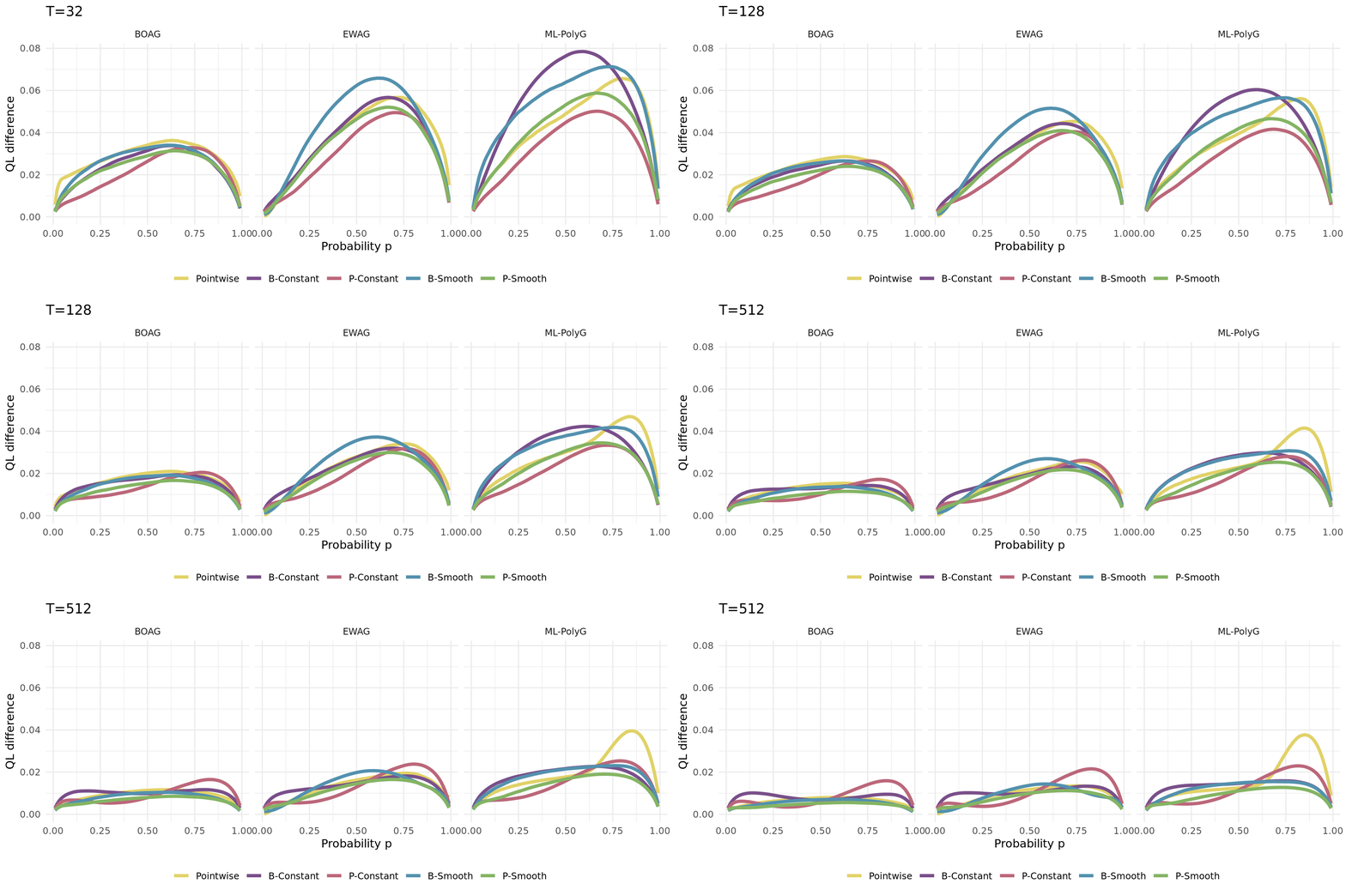
\[\begin{align*} Y_t &\sim \mathcal{N}\left(\frac{\sin(0.005 \pi t )}{2},\,1\right) \\ \widehat{X}_{t,1} &\sim \widehat{F}_{1} = \mathcal{N}(-1,\,1) \\ \widehat{X}_{t,2} &\sim \widehat{F}_{2} = \mathcal{N}(3,\,4) \end{align*}\]
Changing optimal weights
Single run example depicted aside
No forgetting leads to long-term constant weights
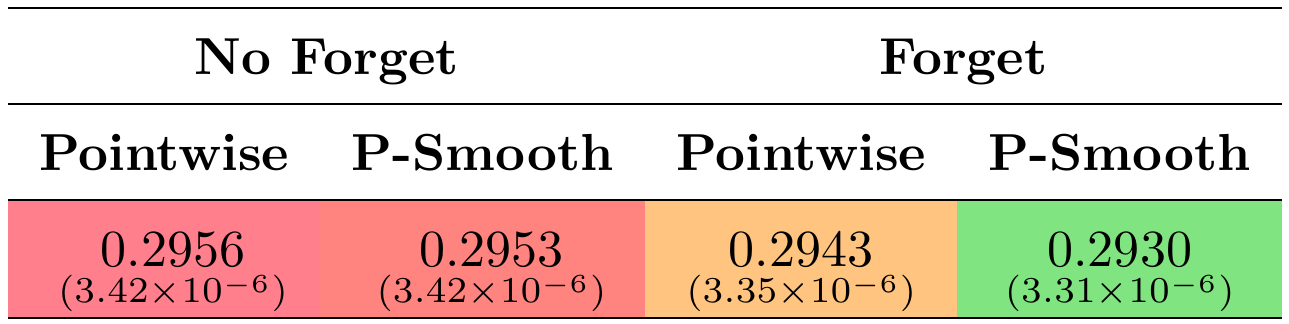
Data:
Combination methods:
Tuning paramter grids:
Simple exponential smoothing with additive errors (ETS-ANN):
\[\begin{align*} Y_{t} = l_{t-1} + \varepsilon_t \quad \text{with} \quad l_t = l_{t-1} + \alpha \varepsilon_t \quad \text{and} \quad \varepsilon_t \sim \mathcal{N}(0,\sigma^2) \end{align*}\]
Quantile regression (QuantReg): For each \(p \in \mathcal{P}\) we assume:
\[\begin{align*} F^{-1}_{Y_t}(p) = \beta_{p,0} + \beta_{p,1} Y_{t-1} + \beta_{p,2} |Y_{t-1}-Y_{t-2}| \end{align*}\]
ARIMA(1,0,1)-GARCH(1,1) with Gaussian errors (ARMA-GARCH):
\[\begin{align*} Y_{t} = \mu + \phi(Y_{t-1}-\mu) + \theta \varepsilon_{t-1} + \varepsilon_t \quad \text{with} \quad \varepsilon_t = \sigma_t Z, \quad \sigma_t^2 = \omega + \alpha \varepsilon_{t-1}^2 + \beta \sigma_{t-1}^2 \quad \text{and} \quad Z_t \sim \mathcal{N}(0,1) \end{align*}\]
ARIMA(0,1,0)-I-EGARCH(1,1) with Gaussian errors (I-EGARCH):
\[\begin{align*} Y_{t} = \mu + Y_{t-1} + \varepsilon_t \quad \text{with} \quad \varepsilon_t = \sigma_t Z, \quad \log(\sigma_t^2) = \omega + \alpha Z_{t-1}+ \gamma (|Z_{t-1}|-\mathbb{E}|Z_{t-1}|) + \beta \log(\sigma_{t-1}^2) \quad \text{and} \quad Z_t \sim \mathcal{N}(0,1) \end{align*}\]
ARIMA(0,1,0)-GARCH(1,1) with student-t errors (I-GARCHt):
\[\begin{align*} Y_{t} = \mu + Y_{t-1} + \varepsilon_t \quad \text{with} \quad \varepsilon_t = \sigma_t Z, \quad \sigma_t^2 = \omega + \alpha \varepsilon_{t-1}^2 + \beta \sigma_{t-1}^2 \quad \text{and} \quad Z_t \sim t(0,1, \nu) \end{align*}\]
| ETS | QuantReg | ARMA-GARCH | I-EGARCH | I-GARCHt |
|---|---|---|---|---|
| 2.101(>.999) | 1.358(>.999) | 0.52(0.993) | 0.511(0.999) | -0.037(0.406) |
| BOAG | EWAG | ML-PolyG | BMA | QRlin | QRconv | |
|---|---|---|---|---|---|---|
| Pointwise | -0.170(0.055) | -0.089(0.175) | -0.141(0.112) | 0.032(0.771) | 3.482(>.999) | -0.019(0.309) |
| B-Constant | -0.118(0.146) | -0.049(0.305) | -0.090(0.218) | 0.038(0.834) | 4.002(>.999) | 0.539(0.996) |
| P-Constant | -0.138(0.020) | -0.070(0.137) | -0.133(0.026) | 0.039(0.851) | 5.275(>.999) | 0.009(0.683) |
| B-Smooth | -0.173(0.062) | -0.065(0.276) | -0.141(0.118) | -0.042(0.386) | - | - |
| P-Smooth | -0.182(0.039) | -0.107(0.121) | -0.160(0.065) | 0.040(0.804) | 3.495(>.999) | -0.012(0.369) |
CRPS difference to Naive. Negative values correspond to better performance (the best value is bold).
Additionally, we show the p-value of the DM-test, testing against Naive. The cells are colored with respect to their values (the greener better).
Berrisch, J., & Ziel, F. (2024). International Journal of Forecasting, 40(4), 1568-1586.
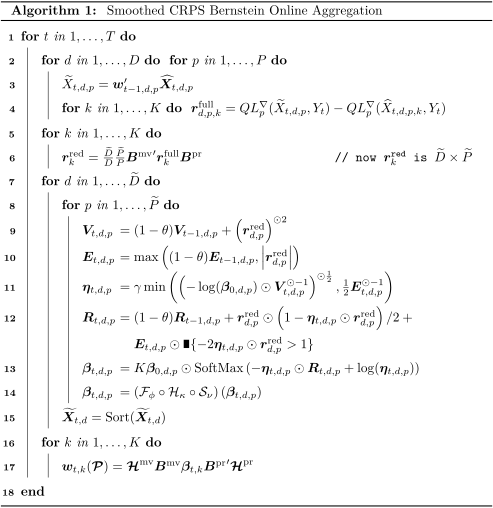
We extend the B-Smooth and P-Smooth procedures to the multivariate setting:
Let \(\boldsymbol{\psi}^{\text{mv}}=(\psi_1,\ldots, \psi_{D})\) and \(\boldsymbol{\psi}^{\text{pr}}=(\psi_1,\ldots, \psi_{P})\) be two sets of bounded basis functions on \((0,1)\):
\[\begin{equation*} \boldsymbol w_{t,k} = \boldsymbol{\psi}^{\text{mv}} \boldsymbol{b}_{t,k} {\boldsymbol{\psi}^{pr}}' \end{equation*}\]
with parameter matix \(\boldsymbol b_{t,k}\). The latter is estimated to penalize \(L_2\)-smoothing which minimizes
\[\begin{align} & \| \boldsymbol{\beta}_{t,d, k}' \boldsymbol{\varphi}^{\text{pr}} - \boldsymbol b_{t, d, k}' \boldsymbol{\psi}^{\text{pr}} \|^2_2 + \lambda^{\text{pr}} \| \mathcal{D}_{q} (\boldsymbol b_{t, d, k}' \boldsymbol{\psi}^{\text{pr}}) \|^2_2 + \nonumber \\ & \| \boldsymbol{\beta}_{t, p, k}' \boldsymbol{\varphi}^{\text{mv}} - \boldsymbol b_{t, p, k}' \boldsymbol{\psi}^{\text{mv}} \|^2_2 + \lambda^{\text{mv}} \| \mathcal{D}_{q} (\boldsymbol b_{t, p, k}' \boldsymbol{\psi}^{\text{mv}}) \|^2_2 \nonumber \end{align}\]
with differential operator \(\mathcal{D}_q\) of order \(q\)
We have an analytical solution.
Linear combinations of bounded basis functions:
\[\begin{equation} \underbrace{\boldsymbol w_{t,k}}_{D \text{ x } P} = \sum_{j=1}^{\widetilde D} \sum_{l=1}^{\widetilde P} \beta_{t,j,l,k} \varphi^{\text{mv}}_{j} \varphi^{\text{pr}}_{l} = \underbrace{\boldsymbol \varphi^{\text{mv}}}_{D\text{ x }\widetilde D} \boldsymbol \beta_{t,k} \underbrace{{\boldsymbol\varphi^{\text{pr}}}'}_{\widetilde P \text{ x }P} \nonumber \end{equation}\]
A popular choice: B-Splines
\(\boldsymbol \beta_{t,k}\) is calculated using a reduced regret matrix:
\(\underbrace{\boldsymbol r_{t,k}}_{\widetilde P \times \widetilde D} = \boldsymbol \varphi^{\text{pr}} \underbrace{\left({\boldsymbol{QL}}_{\mathcal{P}}^{\nabla}(\widetilde{\boldsymbol X}_{t},Y_t)- {\boldsymbol{QL}}_{\mathcal{P}}^{\nabla}(\widehat{\boldsymbol X}_{t},Y_t)\right)}_{\text{PxD}}\boldsymbol \varphi^{\text{mv}}\)
If \(\widetilde P = P\) it holds that \(\boldsymbol \varphi^{pr} = \boldsymbol{I}\) (pointwise)
For \(\widetilde P = 1\) we receive constant weights
Evaluation: Exclude first 182 observations
Extensions: Penalized smoothing | Forgetting
Tuning strategies:
Computation Time: ~30 Minutes
| JSU1 | JSU2 | JSU3 | JSU4 | Norm1 | Norm2 | Norm3 | Norm4 | Naive |
|---|---|---|---|---|---|---|---|---|
| 1.487 | 1.444 | 1.499 | 1.374 | 1.414 | 1.535 | 1.420 | 1.422 | 1.295 |
| Description | Parameter Tuning | BOA | ML-Poly | EWA |
|---|---|---|---|---|
| Constant | 1.2933 | 1.2966 | 1.3188 | |
| Pointwise | 1.2936 | 1.3010 | 1.3101 | |
| FTL | 1.3752 | 1.3692 | 1.3863 | |
| B Constant Pr | 1.2936 | 1.3000 | 1.3432 | |
| B Constant Mv | 1.2918 | 1.2945 | 1.3076 | |
| Forget | Bayesian Fix | 1.2930 | 1.2956 | 1.3096 |
| Full | Bayesian Fix | 1.2905 | 1.2902 | 1.2870. |
| Smooth.forget | Bayesian Fix | 1.2911 | 1.2912 | 1.2869. |
| Smooth | Bayesian Fix | 1.2918 | 1.2917 | 1.2873. |
| Forget | Bayesian Online | 1.2855** | 1.2961 | 1.3098 |
| Full | Bayesian Online | 1.2919 | 1.2873. | 1.2873. |
| Smooth.forget | Bayesian Online | 1.2845** | 1.2862* | 1.2864. |
| Smooth | Bayesian Online | 1.2918 | 1.2918 | 1.2874. |
| Forget | Sampling Online | 1.2855** | 1.2961 | 1.3114 |
| Full | Sampling Online | 1.2886 | 1.2861* | 1.2873. |
| Smooth.forget | Sampling Online | 1.2845*** | 1.2867* | 1.2866. |
| Smooth | Sampling Online | 1.2918 | 1.2917 | 1.2877. |
function updateChartInner(g, x, y, linesGroup, color, line, data) {
// Update axes with transitions
x.domain([0, d3.max(data, d => d.x)]);
g.select(".x-axis").transition().duration(1500).call(d3.axisBottom(x).ticks(10));
y.domain([0, d3.max(data, d => d.y)]);
g.select(".y-axis").transition().duration(1500).call(d3.axisLeft(y).ticks(5));
// Group data by basis function
const dataByFunction = Array.from(d3.group(data, d => d.b));
const keyFn = d => d[0];
// Update basis function lines
const u = linesGroup.selectAll("path").data(dataByFunction, keyFn);
u.join(
enter => enter.append("path").attr("fill","none").attr("stroke-width",3)
.attr("stroke", (_, i) => color(i)).attr("d", d => line(d[1].map(pt => ({x: pt.x, y: 0}))))
.style("opacity",0),
update => update,
exit => exit.transition().duration(1000).style("opacity",0).remove()
)
.transition().duration(1000)
.attr("d", d => line(d[1]))
.attr("stroke", (_, i) => color(i))
.style("opacity",1);
}
chart = {
// State variables for selected parameters
let selectedMu = 0.5;
let selectedSig = 1;
let selectedNonc = 0;
let selectedTailw = 1;
const filteredData = () => bsplineData.filter(d =>
Math.abs(selectedMu - d.mu) < 0.001 &&
d.sig === selectedSig &&
d.nonc === selectedNonc &&
d.tailw === selectedTailw
);
const container = d3.create("div")
.style("max-width", "none")
.style("width", "100%");;
const controlsContainer = container.append("div")
.style("display", "flex")
.style("gap", "20px");
// slider controls
const sliders = [
{ label: 'Mu', get: () => selectedMu, set: v => selectedMu = v, min: 0.1, max: 0.9, step: 0.2 },
{ label: 'Sigma', get: () => Math.log2(selectedSig), set: v => selectedSig = 2 ** v, min: -2, max: 2, step: 1 },
{ label: 'Noncentrality', get: () => selectedNonc, set: v => selectedNonc = v, min: -4, max: 4, step: 2 },
{ label: 'Tailweight', get: () => Math.log2(selectedTailw), set: v => selectedTailw = 2 ** v, min: -2, max: 2, step: 1 }
];
// Build slider controls with D3 data join
const sliderCont = controlsContainer.selectAll('div').data(sliders).join('div')
.style('display','flex').style('align-items','center').style('gap','10px')
.style('flex','1').style('min-width','0px');
sliderCont.append('label').text(d => d.label + ':').style('font-size','20px');
sliderCont.append('input')
.attr('type','range').attr('min', d => d.min).attr('max', d => d.max).attr('step', d => d.step)
.property('value', d => d.get())
.on('input', function(event, d) {
const val = +this.value; d.set(val);
d3.select(this.parentNode).select('span').text(d.label.match(/Sigma|Tailweight/) ? 2**val : val);
updateChart(filteredData());
})
.style('width', '100%');
sliderCont.append('span').text(d => (d.label.match(/Sigma|Tailweight/) ? d.get() : d.get()))
.style('font-size','20px');
// Add Reset button to clear all sliders to their defaults
controlsContainer.append('button')
.text('Reset')
.style('font-size', '20px')
.style('align-self', 'center')
.style('margin-left', 'auto')
.on('click', () => {
// reset state vars
selectedMu = 0.5;
selectedSig = 1;
selectedNonc = 0;
selectedTailw = 1;
// update input positions
sliderCont.selectAll('input').property('value', d => d.get());
// update displayed labels
sliderCont.selectAll('span')
.text(d => d.label.match(/Sigma|Tailweight/) ? (2**d.get()) : d.get());
// redraw chart
updateChart(filteredData());
});
// Build SVG
const width = 1200;
const height = 450;
const margin = {top: 40, right: 20, bottom: 40, left: 40};
const innerWidth = width - margin.left - margin.right;
const innerHeight = height - margin.top - margin.bottom;
// Set controls container width to match SVG plot width
controlsContainer.style("max-width", "none").style("width", "100%");
// Distribute each control evenly and make sliders full-width
controlsContainer.selectAll("div").style("flex", "1").style("min-width", "0px");
controlsContainer.selectAll("input").style("width", "100%").style("box-sizing", "border-box");
// Create scales
const x = d3.scaleLinear()
.domain([0, 1])
.range([0, innerWidth]);
const y = d3.scaleLinear()
.domain([0, 1])
.range([innerHeight, 0]);
// Create a color scale for the basis functions
const color = d3.scaleOrdinal(d3.schemeCategory10);
// Create SVG
const svg = d3.create("svg")
.attr("width", "100%")
.attr("height", "auto")
.attr("viewBox", [0, 0, width, height])
.attr("preserveAspectRatio", "xMidYMid meet")
.attr("style", "max-width: 100%; height: auto;");
// Create the chart group
const g = svg.append("g")
.attr("transform", `translate(${margin.left},${margin.top})`);
// Add axes
const xAxis = g.append("g")
.attr("transform", `translate(0,${innerHeight})`)
.attr("class", "x-axis")
.call(d3.axisBottom(x).ticks(10))
.style("font-size", "20px");
const yAxis = g.append("g")
.attr("class", "y-axis")
.call(d3.axisLeft(y).ticks(5))
.style("font-size", "20px");
// Add a horizontal line at y = 0
g.append("line")
.attr("x1", 0)
.attr("x2", innerWidth)
.attr("y1", y(0))
.attr("y2", y(0))
.attr("stroke", "#000")
.attr("stroke-opacity", 0.2);
// Add gridlines
g.append("g")
.attr("class", "grid-lines")
.selectAll("line")
.data(y.ticks(5))
.join("line")
.attr("x1", 0)
.attr("x2", innerWidth)
.attr("y1", d => y(d))
.attr("y2", d => y(d))
.attr("stroke", "#ccc")
.attr("stroke-opacity", 0.5);
// Create a line generator
const line = d3.line()
.x(d => x(d.x))
.y(d => y(d.y))
.curve(d3.curveBasis);
// Group to contain the basis function lines
const linesGroup = g.append("g")
.attr("class", "basis-functions");
// Store the current basis functions for transition
let currentBasisFunctions = new Map();
// Function to update the chart with new data
function updateChart(data) {
updateChartInner(g, x, y, linesGroup, color, line, data);
}
// Store the update function
svg.node().update = updateChart;
// Initial render
updateChart(filteredData());
container.node().appendChild(svg.node());
return container.node();
}Non-central beta distribution Johnson et al. (1995):
\[\begin{equation*} \mathcal{B}(x, a, b, c) = \sum_{j=0}^{\infty} e^{-c/2} \frac{\left( \frac{c}{2} \right)^j}{j!} I_x \left( a + j , b \right) \end{equation*}\]
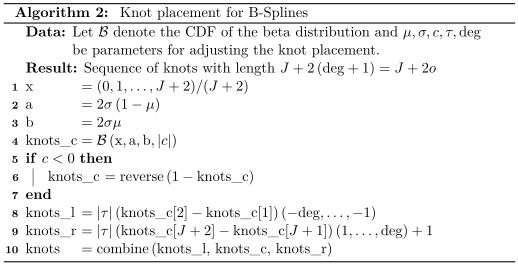
Penalty and \(\lambda\) need to be adjusted accordingly Li & Cao (2022)
Using non equidistant knots in profoc is straightforward:
Basis specification b_smooth_pr is internally passed to make_basis_mats().
Profoc adjusts penatly and \(\lambda\)
Potential Downsides:
Important:
Upsides:
The profoc R Package:
Pubications:
Berrisch, J., & Ziel, F. (2023). CRPS learning. Journal of Econometrics, 237(2), 105221.
Berrisch, J., & Ziel, F. (2024). Multivariate probabilistic CRPS learning with an application to day-ahead electricity prices. International Journal of Forecasting, 40(4), 1568-1586.
Berrisch, J., Pappert, S., Ziel, F., & Arsova, A. (2023). Finance Research Letters, 52, 103503.
Understanding European Allowances (EUA) dynamics is important for several fields:
Portfolio & Risk Management,
Sustainability Planing
Political decisions
EUA prices are obviously connected to the energy market
How can the dynamics be characterized?
Several Questions arise:
EUA, natural gas, Brent crude oil, coal
March 15, 2010, until October 14, 2022
Data was normalized w.r.t. \(\text{CO}_2\) emissions
Emission-adjusted prices reflects one tonne of \(\text{CO}_2\)
We adjusted for inflation by Eurostat’s HICP, excluding energy
Log transformation of the data to stabilize the variance
ADF Test: All series are stationary in first differences
Johansen’s likelihood ratio trace test suggests two cointegrating relationships (levels)
Johansen’s likelihood ratio trace test suggests no cointegrating relationships (logs)
Sklars theorem: decompose target into - marginal distributions: \(F_{X_{k,t}|\mathcal{F}_{t-1}}\) for \(k=1,\ldots, K\), and - copula function: \(C_{\boldsymbol{U}_{t}|\mathcal{F}_{t - 1}}\)
Let \(\boldsymbol{x}_t= (x_{1,t},\ldots, x_{K,t})^\intercal\) be the realized values
It holds that:
\[\begin{align} F_{\boldsymbol{X}_t|\mathcal{F}_{t-1}}(\boldsymbol{x}_t) = C_{\boldsymbol{U}_{t}|\mathcal{F}_{t - 1}}(\boldsymbol{u}_t) \nonumber \end{align}\]
with: \(\boldsymbol{u}_t =(u_{1,t},\ldots, u_{K,t})^\intercal\), \(u_{k,t} = F_{X_{k,t}|\mathcal{F}_{t-1}}(x_{k,t})\)
For brewity we drop the conditioning on \(\mathcal{F}_{t-1}\).
The model can be specified as follows
\[\begin{align} F(\boldsymbol{x}_t) = C \left[\mathbf{F}(\boldsymbol{x}_t; \boldsymbol{\mu}_t, \boldsymbol{ \sigma }_{t}^2, \boldsymbol{\nu}, \boldsymbol{\lambda}); \Xi_t, \Theta\right] \nonumber \end{align}\]
\(\Xi_{t}\) denotes time-varying dependence parameters \(\Theta\) denotes time-invariant dependence parameters
We take \(C\) as the \(t\)-copula
\[\mathbf{F} = (F_1, \ldots, F_K)^{\intercal}\]
\[\begin{align} \Delta \boldsymbol{\mu}_t = \Pi \boldsymbol{x}_{t-1} + \Gamma \Delta \boldsymbol{x}_{t-1} \nonumber \end{align}\]
where \(\Pi = \alpha \beta^{\intercal}\) is the cointegrating matrix of rank \(r\), \(0 \leq r\leq K\).
\[\begin{align} \sigma_{i,t}^2 = & \omega_i + \alpha^+_{i} (\epsilon_{i,t-1}^+)^2 + \alpha^-_{i} (\epsilon_{i,t-1}^-)^2 + \beta_i \sigma_{i,t-1}^2 \nonumber \end{align}\]
where \(\epsilon_{i,t-1}^+ = \max\{\epsilon_{i,t-1}, 0\}\) …
Separate coefficients for positive and negative innovations to capture leverage effects.
\[\begin{align*} \Xi_{t} = & \Lambda\left(\boldsymbol{\xi}_{t}\right) \\ \xi_{ij,t} = & \eta_{0,ij} + \eta_{1,ij} \xi_{ij,t-1} + \eta_{2,ij} z_{i,t-1} z_{j,t-1}, \end{align*}\]
\(\xi_{ij,t}\) is a latent process
\(z_{i,t}\) denotes the \(i\)-th standardized residual from time series \(i\) at time point \(t\)
\(\Lambda(\cdot)\) is a link function - ensures that \(\Xi_{t}\) is a valid variance covariance matrix - ensures that \(\Xi_{t}\) does not exceed its support space and remains semi-positive definite
All parameters can be estimated jointly. Using conditional independence: \[\begin{align*} L = f_{X_1} \prod_{i=2}^T f_{X_i|\mathcal{F}_{i-1}}, \end{align*}\] with multivariate conditional density: \[\begin{align*} f_{\mathbf{X}_t}(\mathbf{x}_t | \mathcal{F}_{t-1}) = c\left[\mathbf{F}(\mathbf{x}_t;\boldsymbol{\mu}_t, \boldsymbol{\sigma}_{t}^2, \boldsymbol{\nu}, \boldsymbol{\lambda});\Xi_t, \Theta\right] \cdot \\ \prod_{i=1}^K f_{X_{i,t}}(\mathbf{x}_t;\boldsymbol{\mu}_t, \boldsymbol{\sigma}_{t}^2, \boldsymbol{\nu}, \boldsymbol{\lambda}) \end{align*}\] The copula density \(c\) can be derived analytically.
=> 2227 potential starting points
We sample 250 to reduce computational cost
We draw \(2^{12}= 2048\) trajectories from the joint predictive distribution
Forecasts are evaluated by the energy score (ES)
\[\begin{align*} \text{ES}_t(F, \mathbf{x}_t) = \mathbb{E}_{F} \left(||\tilde{\mathbf{X}}_t - \mathbf{x}_t||_2\right) - \\ \frac{1}{2} \mathbb{E}_F \left(||\tilde{\mathbf{X}}_t - \tilde{\mathbf{X}}_t'||_2 \right) \end{align*}\]
where \(\mathbf{x}_t\) is the observed \(K\)-dimensional realization and \(\tilde{\mathbf{X}}_t\), respectively \(\tilde{\mathbf{X}}_t'\) are independent random vectors distributed according to \(F\)
For univariate cases the Energy Score becomes the Continuous Ranked Probability Score (CRPS)
Relative improvement in ES compared to \(\text{RW}^{\sigma, \rho}\)
Cellcolor: w.r.t. test statistic of Diebold-Mariano test (testing wether the model outperformes the benchmark, greener = better).
| Model | \(\text{ES}^{\text{All}}_{1-30}\) | \(\text{ES}^{\text{EUA}}_{1-30}\) | \(\text{ES}^{\text{Oil}}_{1-30}\) | \(\text{ES}^{\text{NGas}}_{1-30}\) | \(\text{ES}^{\text{Coal}}_{1-30}\) | \(\text{ES}^{\text{All}}_{1}\) | \(\text{ES}^{\text{All}}_{5}\) | \(\text{ES}^{\text{All}}_{30}\) |
|---|---|---|---|---|---|---|---|---|
| \(\textrm{RW}^{\sigma, \rho}_{}\) | 161.96 | 10.06 | 37.94 | 146.73 | 13.22 | 5.56 | 13.28 | 34.29 |
| \(\textrm{RW}^{\sigma_t, \rho_t}_{}\) | 9.40 | 3.75 | -0.41 | 11.39 | 4.13 | 10.34 | 9.10 | 7.59 |
| \(\textrm{RW}^{\sigma, \rho_t}_{\textrm{ncp}, \textrm{log}}\) | 12.04 | 6.16 | -0.56 | 14.33 | 7.35 | 9.22 | 9.82 | 10.02 |
| \(\textrm{RW}^{\sigma, \rho}_{\textrm{log}}\) | 12.10 | 6.25 | -0.59 | 14.44 | 7.31 | 9.04 | 9.66 | 9.91 |
| \(\textrm{VECM}^{\textrm{r0}, \sigma_t, \rho_t}_{\textrm{lev}, \textrm{ncp}}\) | 9.68 | -0.72 | 0.32 | 11.74 | 3.70 | 10.82 | 10.50 | 8.21 |
| \(\textrm{VECM}^{\textrm{r0}, \sigma, \rho_t}_{\textrm{log}}\) | 12.15 | 6.10 | -0.70 | 14.57 | 7.80 | 8.05 | 9.99 | 10.04 |
| \(\textrm{ETS}^{\sigma}\) | 9.94 | 5.75 | 0.08 | 13.05 | 7.83 | 6.96 | 7.74 | 6.21 |
| \(\textrm{ETS}^{\sigma}_{\textrm{log}}\) | 8.12 | 7.80 | -0.51 | 11.17 | 8.54 | 5.05 | 6.14 | 2.66 |
| \(\textrm{VES}^{\sigma}\) | 5.50 | -4.43 | -3.22 | 6.29 | 4.68 | -25.99 | -2.42 | 3.07 |
| \(\textrm{VES}^{\sigma}_{\textrm{log}}\) | 7.68 | 3.31 | -4.34 | 9.07 | 8.30 | -22.11 | 1.07 | 4.32 |
Improvement in CRPS of selected models relative to \(\textrm{RW}^{\sigma, \rho}_{}\) in % (higher = better). Colored according to the test statistic of a DM-Test comparing to \(\textrm{RW}^{\sigma, \rho}_{}\) (greener means lower test statistic i.e., better performance compared to \(\textrm{RW}^{\sigma, \rho}_{}\)).
EUA
|
Oil
|
NGas
|
Coal
|
|||||||||
|---|---|---|---|---|---|---|---|---|---|---|---|---|
| Model | H1 | H5 | H30 | H1 | H5 | H30 | H1 | H5 | H30 | H1 | H5 | H30 |
| \(\textrm{RW}^{\sigma, \rho}_{}\) | 0.4 | 0.9 | 2.1 | 1.5 | 3.4 | 9.1 | 4.7 | 11.6 | 29.8 | 0.3 | 0.9 | 2.8 |
| \(\textrm{RW}^{\sigma_t, \rho_t}_{}\) | 5.6 | 6.0 | 2.8 | 2.1 | 2.7 | -0.8 | 12.6 | 10.5 | 9.6 | 10.7 | 6.5 | 2.1 |
| \(\textrm{RW}^{\sigma, \rho_t}_{\textrm{ncp}, \textrm{log}}\) | 5.1 | 8.7 | 5.0 | 0.7 | 0.8 | -0.4 | 11.4 | 11.5 | 12.4 | 8.0 | 7.3 | 6.7 |
| \(\textrm{RW}^{\sigma, \rho}_{\textrm{log}}\) | 4.7 | 8.9 | 5.2 | 0.0 | 0.3 | -0.6 | 11.2 | 11.4 | 12.4 | 7.7 | 7.5 | 6.6 |
| \(\textrm{VECM}^{\textrm{r0}, \sigma_t, \rho_t}_{\textrm{lev}, \textrm{ncp}}\) | 3.6 | 0.6 | -1.6 | 2.7 | 3.0 | 0.0 | 13.1 | 12.2 | 10.4 | 11.8 | 7.2 | 1.5 |
| \(\textrm{VECM}^{\textrm{r0}, \sigma, \rho_t}_{\textrm{log}}\) | 4.2 | 8.9 | 5.1 | 0.2 | 0.4 | -0.8 | 9.9 | 11.8 | 12.7 | 7.8 | 7.9 | 7.3 |
| \(\textrm{ETS}^{\sigma}\) | 0.2 | 6.8 | 5.7 | 1.1 | 0.9 | -0.2 | 10.9 | 11.3 | 10.9 | 7.5 | 6.7 | 5.6 |
| \(\textrm{ETS}^{\sigma}_{\textrm{log}}\) | 1.0 | 8.6 | 8.0 | 0.1 | 0.7 | -0.6 | 8.9 | 9.4 | 7.1 | 7.3 | 7.8 | 6.7 |
| \(\textrm{VES}^{\sigma}\) | -38.5 | -6.4 | -5.4 | -33.3 | -6.1 | -2.4 | -26.6 | -2.6 | 3.6 | -37.5 | -5.5 | 4.7 |
| \(\textrm{VES}^{\sigma}_{\textrm{log}}\) | -32.4 | 2.8 | 1.8 | -30.4 | -6.2 | -3.2 | -22.0 | 1.8 | 5.4 | -27.0 | 2.3 | 6.4 |
RMSE measures the performance of the forecasts at their mean
Conclusion: the Improvements seen before must be attributed to other parts of the multivariate probabilistic predictive distribution
Improvement in RMSE score of selected models relative to \(\textrm{RW}^{\sigma, \rho}_{}\) in % (higher = better). Colored according to the test statistic of a DM-Test comparing to \(\textrm{RW}^{\sigma, \rho}_{}\) (greener means lower test statistic i.e., better performance compared to \(\textrm{RW}^{\sigma, \rho}_{}\)).
EUA
|
Oil
|
NGas
|
Coal
|
|||||||||
|---|---|---|---|---|---|---|---|---|---|---|---|---|
| Model | H1 | H5 | H30 | H1 | H5 | H30 | H1 | H5 | H30 | H1 | H5 | H30 |
| \(\textrm{RW}^{\sigma, \rho}_{}\) | 0.9 | 2.0 | 5.0 | 2.9 | 6.4 | 16.7 | 17.8 | 42.8 | 85.4 | 0.9 | 2.9 | 7.0 |
| \(\textrm{RW}^{\sigma_t, \rho_t}_{}\) | -0.1 | -0.1 | 0.7 | 0.0 | -0.3 | -0.1 | -0.2 | 0.3 | 1.3 | -0.2 | 0.0 | -1.8 |
| \(\textrm{RW}^{\sigma, \rho_t}_{\textrm{ncp}, \textrm{log}}\) | -270.5 | -154.1 | -139.9 | 0.5 | -0.5 | -2.9 | -0.8 | 0.7 | -1.6 | 0.3 | -31.2 | -24.5 |
| \(\textrm{RW}^{\sigma, \rho}_{\textrm{log}}\) | -705.0 | -265.4 | -125.2 | 0.6 | 0.2 | -0.2 | -0.4 | 0.1 | -1.6 | -0.9 | -0.3 | -8.3 |
| \(\textrm{VECM}^{\textrm{r0}, \sigma_t, \rho_t}_{\textrm{lev}, \textrm{ncp}}\) | -0.9 | 0.2 | 0.5 | 0.5 | 0.2 | 0.0 | -0.4 | 0.7 | 0.2 | 1.4 | 0.1 | 0.2 |
| \(\textrm{VECM}^{\textrm{r0}, \sigma, \rho_t}_{\textrm{log}}\) | -271.5 | -191.3 | -114.3 | 1.7 | -12.3 | -3.6 | -0.6 | 1.6 | -4.1 | 0.0 | -0.8 | -6.7 |
| \(\textrm{ETS}^{\sigma}\) | -0.3 | 0.3 | 1.6 | 0.7 | 0.1 | -0.1 | 0.1 | -0.1 | 0.2 | -2.4 | -3.9 | 2.5 |
| \(\textrm{ETS}^{\sigma}_{\textrm{log}}\) | -1.0 | 0.4 | 1.6 | 0.9 | 0.0 | -0.1 | -1.9 | -1.9 | -13.9 | -0.3 | -3.6 | -1.8 |
| \(\textrm{VES}^{\sigma}\) | -37.4 | -8.9 | -6.0 | -27.9 | -7.4 | -2.8 | -27.2 | -9.5 | -2.4 | -41.7 | -1.2 | 1.6 |
| \(\textrm{VES}^{\sigma}_{\textrm{log}}\) | -37.6 | -9.2 | -7.8 | -26.8 | -7.3 | -3.0 | -27.0 | -6.8 | -3.5 | -41.2 | -2.2 | -0.3 |
Accounting for heteroscedasticity or stabilizing the variance via log transformation is crucial for good performance in terms of ES
Theoretical
Probabilistic Online Learning:
Aggregation
Regression
Practical
Applications
Energy Commodities
Electricity Prices
Electricity Load
Well received by the academic community:
of papers already published
104 citations since 2020 (Google Scholar)
Software
R Packages:
Python Packages:
Contributions to other projects:
RcppArmadillo
gamlss
NixOS/nixpkgs
OpenPrinting/foomatic-db
Awards:
Berrisch, J., Narajewski, M., & Ziel, F. (2023):
Won Western Power Distribution Competition
Won Best-Student-Presentation Award